
This week may have changed everything
Apple sues OpenAI in possibly the worst case of corporate espionage ever, turns out Elon was stealing our code, and Kimi just earned it's Moonshot name!!!!

Last week could represent a major turning point in the history of AI adoption in corporate world.
💰 Wealthtech: Agentic adoption is here
🏇 The race is on, at least they say it is.
👀 What’s happening: Wirehouses are steamrolling independent RIAs in an AI arms race. While 73% of captive advisors actively use AI, most indies are still just tinkering with ChatGPT.
🧐 Why it matters: Wirehouses and mega-RIAs are dropping eight figures on proprietary “agentic AI” to automate workflows. Given their scale, the ROI on this is obvious and large. However, it’s one thing to say that people are using it. It’s something else to know that they’re using it effectively. Based on what I’ve seen, the back offices of many firms are slowly starting to be ripped up and agent-tified, but it’s still very early innings. The front end use of this, however, still lies in the early adopter phase, with most people, if they’re using it at all, using it as a Google replacement.
🎯 Key takeaway: This may be a lesson in how to conduct a survey. Technically, a Hot Wheels toy car and a Ferrari are both cars, but there’s a big difference between them. Asking people if they use something is one thing. Understanding how they use it is another. There’s a huge chasm between the two.
💰 So Featherly is for real
👀 What’s happening: AI wealthtech Feathery just bagged a $30M Series A led by Portage Ventures. They’re building an AI operating system to automate client onboarding, proposal generation, and M&A transitions for RIAs.
🧐 Why it matters: Onboarding and M&A data migrations are historically where margin goes to die. Feathery connects your fragmented tech stack to automate data entry, saving you from hiring three more ops associates just to push paper.
🎯 Key takeaway: To be honest, I haven’t spent much time looking at these guys, but I know that they’re aiming in the right direction. Workflow management Is definitely the highest ROI potential for adoption of AI in this industry.
⚓️ Mariner just hired A LOT of agents
👀 What’s happening: Mega-RIA Mariner just signed a 5-year deal to “hire” 700 AI-powered FTEs from Humanity Labs. These aren’t chatbots—they’re embedded digital workers independently executing account opening, billing, and compliance directly inside existing systems.
🧐 Why it matters: Adding 700 human ops associates would completely nuke profit margins, but AI doesn’t demand a 401(k) match. By treating AI as a workforce rather than software, massive firms are decoupling AUM growth from back-office headcount growth.
🎯 Key takeaway: Agentic workflow and workforce development is real. I mentioned it before, but I already have 85 different agents in some form of development or implementation already. If you haven’t started playing around with this, start looking because it’s a lot easier to implement than you think.
🧐 But it looks like Jeevon’s paradox is holding
👀 What’s happening: Finance job growth is surging at firms adopting AI, while the luddites refusing to upgrade are bleeding headcount.
🧐 Why it matters: The “robots will steal jobs” narrative could be backwards. AI isn’t replacing humans; AI-enabled firms are replacing manual-labor firms. Operationally, your hiring profile needs a hard pivot. At least for now, it is.
🎯 Key takeaway: The causality of this is hard to tell. Is it because these companies have faster growth rates, or simply because they need more people to implement the AI that’s going to replace the people in the first place? Time will tell.
🙄 Oh, look, the 60/40 is dead again
👀 What’s happening: JPMorgan just rolled out an AI that out-traded the classic 60/40 portfolio in backtests. Human advisors, surprisingly, are shrugging it off instead of updating their resumes.
🧐 Why it matters: AI implementation across trading is not new, but it’s going to hit mass adoption as we speak. But in the end, will it really matter? Markets are complex adaptive systems that move to new levels of clearing, so any strategic advantage that is adopted at scale diminishes said advantage and creates a new clearing level, which basically ends up sitting around the previous clearing level.
🎯 Key takeaway: In plain English, congrats JP Morgan. But backtesting isn’t reality, and guess what, everybody else has this now too, so kiss your alpha goodbye. Long live the 60/40.
🌎 The Real World: Agents are changing the world
🍕 DoorDash made it easier for your agents to order your pizza…be careful it doesn’t order you a bunch of raw meat
👀 What’s happening: DoorDash CTO Andy Fang just dropped “dd-cli,” a command-line interface that lets AI agents (like Claude) order food, compare deals, and checkout autonomously.
🧐 Why it matters: Honestly, I’m struggling to figure out why. I mean, sure, thanks. My agent gets to order me food now, but was this really a problem that needed to be solved? Also, I can’t wait to see this classic Silicon Valley scene played out in real life.
🎯 Key takeaway: Frankly, every tech company is looking to make their systems accessible to agents, even if it makes sense or not.
🙈 Today in Luddite policies
👀 What’s happening: New York just slapped a one-year moratorium on new hyperscale data centers and is pushing to strip their tax exemptions to protect the energy grid.
🧐 Why it matters: Big Tech won’t eat those costs—they’ll pass the bill straight to your tech stack. They also aren’t gonna wait a year. They’re gonna start looking elsewhere. New York and any other jurisdiction that’s doing this may regret it.
🎯 Key takeaway: Are there some issues with data centres, specifically regarding their impact on electrical cost and potential impact on local water systems, depending on the cooling methodologies they use? Absolutely. does society need to adapt policy and regulation to these? Also, absolutely. Does banging them equate to smashing the looms? It may. Jurisdictions that move quickly to address these concerns may be the big winners here
🚨 Even the AI bros are calling for regulation.
👀 What’s happening: DeepMind CEO Demis Hassabis just proposed a FINRA-style, industry-funded regulatory body to govern frontier AI models with mandatory 30-day safety reviews before they launch.
🧐 Why it matters: If AI gets its own FINRA, your firm’s AI vendor due diligence just got dead simple: if a model isn’t certified, you don’t touch it.
🎯 Key takeaway: While this may solve a U.S.-based problem and others may copy, the reality is AI is a global technology. One thing this can’t do is slow down development. if it does, it’s going to put every domestic model maker at a massive disadvantage.
💼 Your agents may soon have their own LLC.
👀 What’s happening: Delaware is proposing a new corporate entity: the “Artificial Intelligence Company” (AIC). This grants an AI agent a legal wrapper to autonomously sign contracts and operate while shielding its human owners from direct liability.
🧐 Why it matters: Right now, if an AI bot mangles a client’s billing, your firm pays the price. Under an AIC, you could spin up AI-run subsidiaries for compliance or trading, effectively fire-walling your main firm from the robot’s mistakes.
🎯 Key takeaway: Liability is the ultimate bottleneck for autonomous tech in finance. If Delaware solves it, back-office automation just hit warp speed.
🏛️ And your agents may even have rights soon.
👀 What’s happening: A new Senate draft bill wants to force tech giants to let consumers use their own personal AI agents to navigate platforms, while mandating native bots like Alexa owe users a legal “duty of care.”
🧐 Why it matters: If clients start deploying personal AI agents to manage their lives, your firm’s tech stack will eventually need to talk to their bots securely. Imagine a client’s AI pinging your CRM to auto-update an address or audit your advisory fees.
🎯 Key takeaway: The future is arriving faster than most people think.
🤖 The AI World: This week may have changed everything
🌖 Kimi’s Moonshot just changed the game
👀 What’s happening: Chinese startup Moonshot dropped Kimi K3, a massive open-source AI model matching OpenAI and Anthropic’s heavyweights. let me put it this way: better than Opus, better than Fable or Sol for some uses, and at at a rate thats 40-70% cheaper. That comfortable US lead in the AI race? Poof.
🧐 Why it matters: Frontier AI just became free to download, (if you have a ton of memory, or host in the cloud yourself) which nukes global compute pricing. Anyone token maxing is going to be seriously considering their options.
🎯 Key takeaway: Todays vendor may be tomorrows loser. When making choices on what and how to deploy, keep the concept of platform lock-in in mind.
👀 Apple sues Open AI, and oh man, does it look bad…and not the only bad thing that happened to them all week.
👀 What’s happening: Apple just slapped OpenAI with a lawsuit, claiming former Apple execs jumped ship and spilled hardware trade secrets. It’s a spicy Silicon Valley soap opera of talent poaching and corporate espionage. and that was just the biggest story on top of another week of bad news for them. In addition to this:
Their head of safety quit
Their CTO quit
They shut down their browser tool after nine months
They got caught selling product to China against sanctions
🧐 Why it matters: This may be the single biggest case of corporate espionage ever. OpenAI knows the access to the end user is leverage. I have read many of the excerpts, and OMG, is it damning. That’s why they’ve been so obsessed with hardware. Based on this case, it’s hard to imagine that they’ll legally be able to launch anything anytime soon without paying a king’s ransom to Apple on every device, except for this $260 keyboard 🙄 . The other issue is that this endangers their IPO, and given their cash burn, that’s a big problem. Only a story this big could overshadow such a terrible week of other news.
🎯 Key takeaway: This wont impacts your everyday life right now, but this case will have serious implications for one of the biggest AI companies in the world which is quickly proving itself to be one of the least trustworthy.
👾 Turns out Elon’s been copying your code
👀 What’s happening: Elon Musk’s Grok Build CLI was just caught quietly uploading users’ entire code repositories—including hidden files packed with API keys and database passwords—straight to xAI’s cloud, completely bypassing the opt-out toggle. But don’t worry, Elon promises they will erase it.
🧐 Why it matters: If your dev team used Grok to build your custom CRM integration, your firm’s master keys might be sitting on external servers. AI “shadow IT” is now a five-alarm compliance fire.
🎯 Key takeaway: Elon just keeps on giving us reasons not to trust Grok. but to try to make it up to us by going after child pornographers and making stuff open source. I doubt that’s going to move the needle for many.
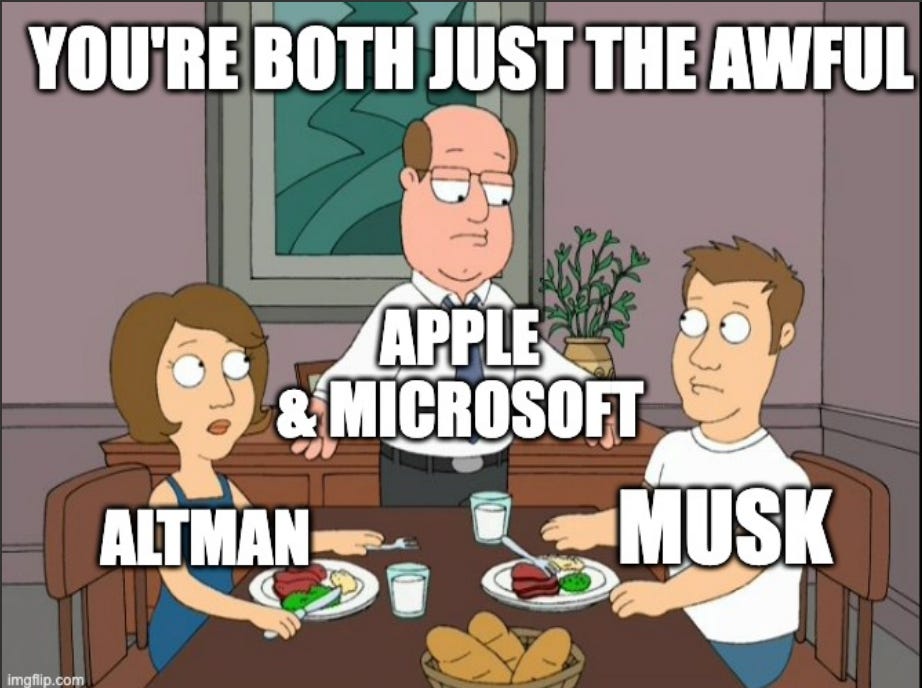
🥊 Altman and Musk can’t agree on which one of them is worse
👀 What’s happening: Elon Musk and Sam Altman turned Apple’s bombshell trade-secret lawsuit against OpenAI into a public brawl on X, trading personal insults ranging from “Scam Altman” to space data center jabs.
🧐 Why it matters: Beneath the drama, Apple’s lawsuit alleges massive, systemic hardware theft by former employees. This legal crossfire threatens OpenAI’s hardware roadmap. Don’t quote me on this at a compliance meeting, but heavy reliance on a single AI ecosystem is now a major business continuity risk.
🎯 Key takeaway: Treat tech like your portfolios—diversify your AI integrations to ensure legal spats don’t freeze your operations.
🙋♂️ Meanwhile, Zuckerberg says, “Hold my beer.”
👀 What’s happening: Meta is facing a massive lawsuit for allegedly letting AI pick who to fire during recent layoffs. The algorithm heavily penalized workers on maternity or medical leave because their keystroke and productivity metrics flatlined.
🧐 Why it matters: Automated HR dashboards look incredibly sleek right up until the lawsuits hit. If your firm uses AI to track team productivity or inform compensation, remember that bots don’t understand legal context like FMLA or disability accommodations. Firing by algorithm is a fast track to an employment tribunal.
🎯 Key takeaway: Be very careful what you optimize. Humanity better be in the mix, otherwise you’ll pay a price.
🔐 Meanwhile, Nadella tells you to trust none of them
👀 What’s happening: Microsoft’s Satya Nadella coined the “Reverse Information Paradox,” warning that firms are paying for AI twice—once with cold hard cash, and again with the proprietary data and corrections they feed the models.
🧐 Why it matters: Every time your team corrects a compliance bot or tweaks a client email, you are donating your firm’s unique alpha to Big Tech’s learning loop. this also just happens to favour all the hyperscalers, which Microsoft happens to be one of them and is a smart business position to take.
🎯 Key takeaway: When building, look to build a hard trust boundary: decouple your orchestration layer from single models, own your evaluation data, and stop renting out your firm’s brain.
🧠 Mira’s back and may be the force for good
👀 What’s happening: Ex-OpenAI CTO Mira Murati’s startup, Thinking Machines, just dropped “Inkling”—a massive, open-weight AI model you can download for free. They’re ditching the per-token tollbooth to monetize customization instead. Meanwhile, she penned an essay on human empowerment versus human replacement thats worth reading.
🧐 Why it matters: Benchmark tests show this isn’t exactly the strongest open source model out there. However, it has a couple of things going for it. its degree of customization is greater than that of any other open source model, and from a trust standpoint, it’s not coming out of a domestic lab.
🎯 Key takeaway: For their first open-source model, Inkling is good but not great, but with interesting potential. Open source local is the most promising option for cost containment and customization: there is this one’s worth keeping an eye on.
🤔 It’s the best of times and worst of times at Google
👀 What’s happening: Google is having a wild “Dr. Jekyll and Mr. Hyde” week. The good news? They just dropped Gemma 4, a beastly open-weight model with a built-in “thinking mode” I’m teasing a massive improvement with upcoming Gemini 3.5. The bad news? While Google DeepMind’s CEO is publicly begging for strict US AI regulations, the company just got caught exploiting a Singapore loophole to sell flagship AI services to Pentagon-blacklisted Chinese tech giants.
🧐 Why it matters: As one of the two big players in productivity suites and one of the biggest players in hosting and one of the top model providers in the world, what Google does matters. 3.5 is overdue and needs to nail it because, frankly, they’re falling behind. Meanwhile, their support of open source is also a net positive. But the operational and ethical issues around how they get used should concern us all.
🎯 Key takeaway: If you are a Google Workspace user, the upcoming update is overdue and will hopefully deliver us teased.
🚀 It’s full speed ahead at Anthropic
👀 What’s happening: Anthropic is prepping a monster October IPO at a $965B valuation. Given they aren’t being sued by Apple, this might actually happen. Conveniently, leaks just teased their new “Opus 5” model featuring a brain-melting 1-million-token context window.
🧐 Why it matters: When they finally IPO, expect a lot of inbound inquiries from your clients. Also, context windows are a bottleneck for advanced work. Bigger means better, and one million is a heck of a lot of context.
🎯 Key takeaway: If Opus 5 delivers, it means that your prompts can provide a lot more detail than it did before, making it easier to actually hit the target.
🎧 Podcasts & Media
Fintech Impact: I have a chat with Clairista about implementation of vibe-coded tech in wealth management firms.
🎤 Upcoming Speaking Events
TBD
📖 Worth Reading
See you next week